A Musical Offering
by Jodie Jensen
It is not often that we, as musicians, have the chance to do something meaningful outside our local communities. Most of our efforts to bring music and music education to the thousands of school aged children and adults of our communities go unnoticed and unheralded as we try to make our local community a better place. As a piece of graffiti from the Berlin Wall explained, 'Many small people, who in many small places do many small things, can alter the face of the world.' It was in May of 2009 that I was given the chance to do a ‘small thing’ outside my community and use skills I have learned at the Keyboard Ensemble and Technology workshop to help build a community using music and theater.
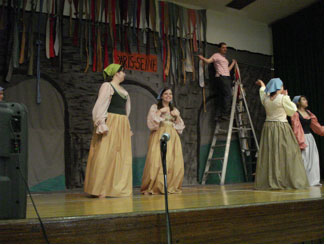
In December of 2008 my daughter, Britta Jensen, had just completed four months as a teacher for the Department of Defense Schools (DODEA) in Daegu, South Korea. Her area of specialty was teaching English and Theater Arts to Middle School and High School students. Upon arrival in Daegu she learned that the school did not have a drama program and had not produced any kind of production in over 8 years. It had been an even longer period of time since the community had produced any kind of theater production. As a warrior for the use of theater and drama to build literacy, Britta had moved to the right community to use the skills she learned under the tutelage of Larry Sacharow, head of the drama department at Fordham University and Award winning director of Edward Albe 's Three Tall Women.
Since Britta's arrival in Daegu in August 2008 she started to build a small drama and forensics program at the Daegu American School but had bigger visions of producing a large spring event that would include as many kids as possible as well as extend an invitation of participation to the active duty military and civilian worker community. She felt that by including solid role models for kids, the students would benefit from the knowledge base these adults could provide since many kids lived in single parent homes or had a family member who was deployed. A theater production would also give adult mentors a meaningful activity to fill up some of those off-duty hours and give soldiers an alternative to some of the less desirable activities available off base.
Her dream was to bring a musical to Daegu American School that would teach a number of different life skills while feeding the emotional needs of the Army personnel and give them some comfort in this war torn time. After much deliberation, Britta felt that Les Miserable’s by Victor Hugo would be the best musical for this community. Les Mis’s story line talks about what can happen when one decides to overcome life’s circumstance and lead a meaningful life. Some of the lyrics of the music sing about losing comrades and friends to conflict and the beauty of forgiveness. The message of the play conveyed hope and this community needed some hope.
During Christmas vacation we rented the Broadway production of Les Miserable's, were moved and inspired by the music and message. The magnitude of how one would produce such a monumental project was discussed. After much discussion, Britta decided that the musical was "do-able" and that if I, her mom, could help out with the music; the project would be a success. Little did any of us know what we were involving ourselves in.
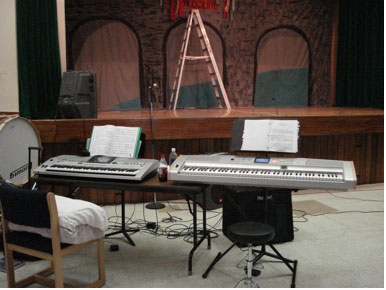
The Keyboard Ensemble and Technology Seminar information (KETS as it is affectionately known) was a breeding ground of possibility. Because of my attendance at these summer workshops, I had a few of the skills needed to start work on the music for this project. Because the Daegu American School is very small, 350 kids in a K-12 school, there were not enough musicians to practice and perform the orchestral score of the musical. However, using Yamaha technology, we could sequence 16 tracks of music to produce a musical recording for students to practice with and then bring those MIDI files to Daegu for a live performance using two keyboards side by side, one keyboard manned by a student musician and one manned by me. Music was purchased for vocal solo, choral and orchestral scores. As each vocal number was sequenced, it was turned into and MP-3/Wave file, uploaded onto the internet using Yahoo Groups and sent to South Korea. Since the school did not have a MIDI capable keyboard, I would have to bring my Yamaha 900 PSR or ask Yamaha to assist us in locating a music dealer in Daegu who could provide us with a Clavinova.
As students prepared for this event, the community was moved into action by the very energy of the production. Soldiers, enlisted personnel and officers, auditioned for parts. Those knowledgeable in sound/lighting/set-building came forward to work with students in the building of sets and sound boards. AFRTS radio gave interviews and advertisement. Korean tailors and parents made costumes and parents provided meals for the actors. The community had not seen this much mobilization of effort since the Korean War. Kids refused to go to sports practice in order to make Les Mis rehearsals. The whole school was involved with music teachers giving up practice space, musicians and percussion instruments so the production could take place. The school administrators were on board and supportive.
In short a miracle took place in this community. Base philanthropic organizations gave thousands of dollars to pay for sets, costumes and musical scores. In the end the base commanders, missionary groups and the greater Daegu community came together to lend their support for this production. For both nights of the production there was a full house in attendance.
The production did not go off without a number of hitches, but by the time the production was ready to roll these kids, teachers and community members had learned some valuable lessons such as:
- The worth of practice and commitment. Most of the student performers had no idea the hours it takes to bring a polished production to an audience. They assumed that drama and music were magic. Boy did they learn the hard truth.
- Communication skills. You need to give your parents the rehearsal and performance schedule. You need to make your audience believe in what you are saying. You need to internalize the message so you can communicate the message.
- There is more to being an actor than being the "Star". There are no small parts, only small actors.
- Theater and music are processes. You need to become comfortable with the process and enjoy every aspect of the production. Applause happens after the process has taken place.
- Leadership. If you say that you will take charge of something, everyone is counting on you to do your job.
- Sets, lights, music and sound. All these are the essence of a good production. Without those individuals working off stage, your job on stage is worth much less. We need everyone and everyone’s job is important down to the person in the costume room who mends the rips in the costume.
- Students found their voice. As I watched students, who had no idea they had any talent find their voice, I was moved to tears. They learned that they can, no matter where they are in the world, learn and make a difference.
- Our troops are tender and need the cultural arts to heal the wounds of war. They need things that build the spirit and help them to express themselves in appropriate ways.
Landing in Korea was the icing on the cake. From the time I arrived in country to the day I left,
I was part of something bigger than myself. There was not a single ungrateful student performer. I heard the word ‘thank you’ over and over again. To watch this group of over 35 kids (not including all the adults) grow and develop; to hear them sing the Finale of Les Miserable, I realized that each child in this play was part of a miracle. There was no one left unmoved by this production. It was not a Broadway level production by any means, but what community theatre production is professional. What this musical did for the psyche of each performer and support staff was allow them to dream and become part of a collective body that could make change where change was most needed…in their own heart.
My husband and I were able to return this past November to visit with the kids who participated in this musical. Some of the kids needed a reminder of the great impact their participation in Les Mis had on the community. They shed tears at the joy they felt as part of this production. For one girl, this production has enabled her to find her path as a theater arts major working in sound design. Daegu American School now has an active drama program. The base community is in the process of refurbishing their old base community theater so that the arts will become a bigger part of the lives of the military and civilian personnel on the base. The commander of the base saw, first hand, what theater and music can do for the morale and welfare of the warrior.
It was an honor to be asked to participate in this production. I learned to love the students and the work being done in this quiet, out of the way place. Without the education I received at KETS and without the devoted teachers and seminar instructors at KETS, I would not have been able to produce the music for this event.
Thank you KETS.